
The initial trial in 2012 and 2013 found that SMART Approaches reduced flight times and led to a significant reduction in fuel burn and carbon emissions.
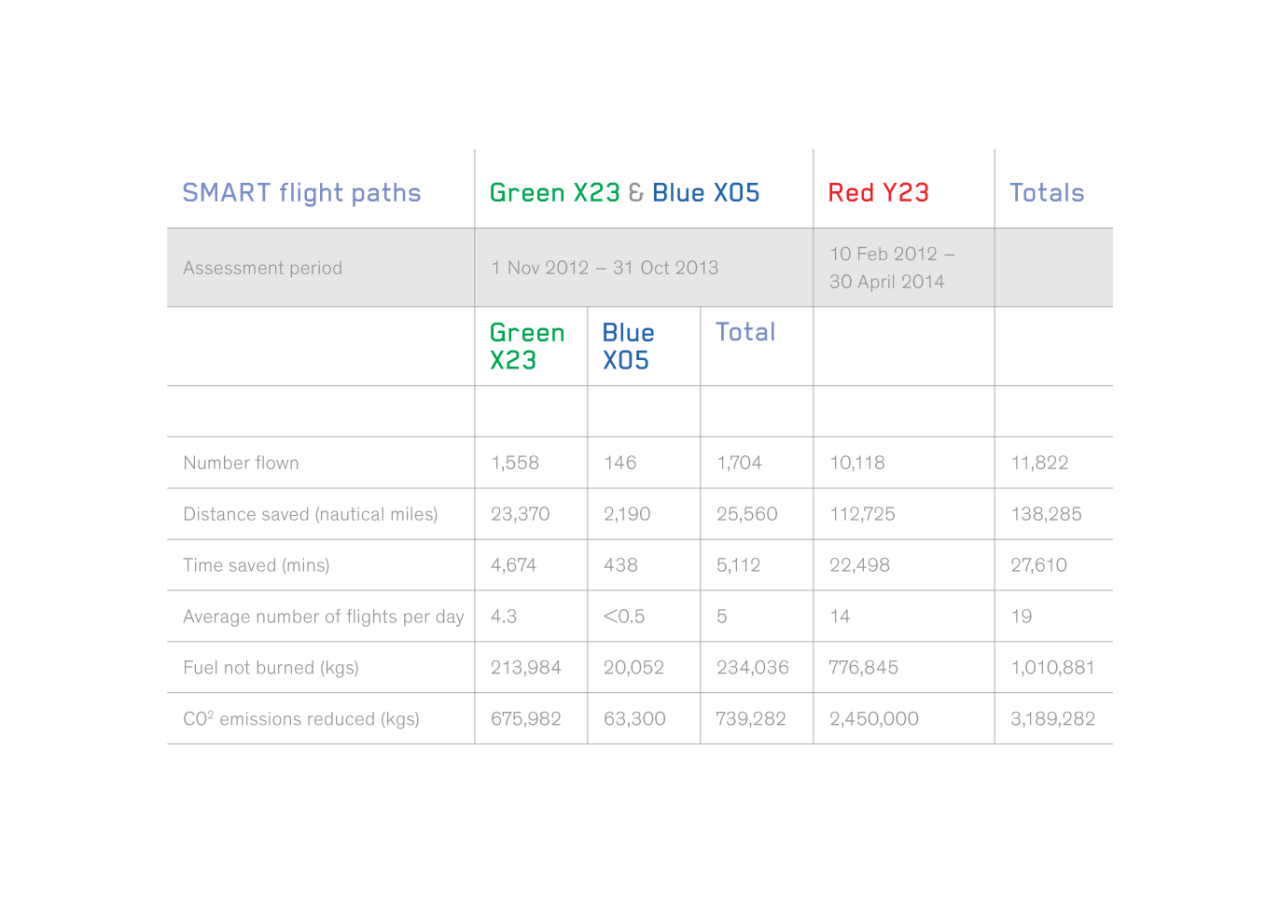
During the course of this initial trial, an average of 20 flights per day used the SMART Approaches and flew 151,185 fewer nautical miles, resulting in a 3.357 million kilogramme reduction in carbon dioxide emissions and a 1.064 million kilogramme reduction in fuel use. Additional results are in the table below.
Independent acoustics consultants also measured the impact of SMART Approaches on noise levels over residential areas. They determined that while individual SMART flights had marginally higher noise levels (approximately three decibels higher on average), the difference was not regarded as significant and would be expected to be only just perceptible to the human ear. The one exception to this was at Reinheimer Place in Flat Bush, where the difference was a perceptible seven decibels.
Since September 2015, all jets flying conventional flight paths from the north were no longer permitted to make visual approaches to Auckland Airport. Visual approaches are considered to create more noise than instrument-based approaches. Visual approaches to the airport from the north by wide-body jets, such as the B777, were stopped in September 2014.
In April 2015, Auckland Airport, the Board of Airline Representatives New Zealand (BARNZ) and Airways New Zealand announced that two new SMART satellite-guided flight paths to Auckland Airport from the North would come into permanent operation from 28 May 2015.
The decision to implement the two satellite-guided flight paths was publicly announced in December 2014, following a trial and public consultation process. The new flight paths which have been implemented were modified as a result of feedback from the trial and public consultation to reduce aircraft noise, use even less fuel and deliver benefits for the environment. Each of these flight paths can be used between 7am and 10pm by up to 10 aircraft per day.
Satellite guidance enables aircraft to fly an improved flight path and these two new flight paths are higher in places, and their approach curves wider, than the paths used in the trial. This means that aircraft can reduce the use of thrust and speed brakes, making them quieter and allowing the aircraft to save fuel, cut carbon emissions and land more efficiently.
The new paths contribute to the modernisation of airspace and air navigation in New Zealand, by improving the efficiency of air traffic movements. The benefits for New Zealand include a commitment to the continued improvement of aviation safety, lower aircraft operating costs through fuel savings and lower carbon emissions.
With more than 420 flights every day, Auckland Airport connects Auckland to the rest of New Zealand and the world. These new satellite-guided flight paths will help grow travel, trade and tourism in an environmentally friendly and socially responsible manner.
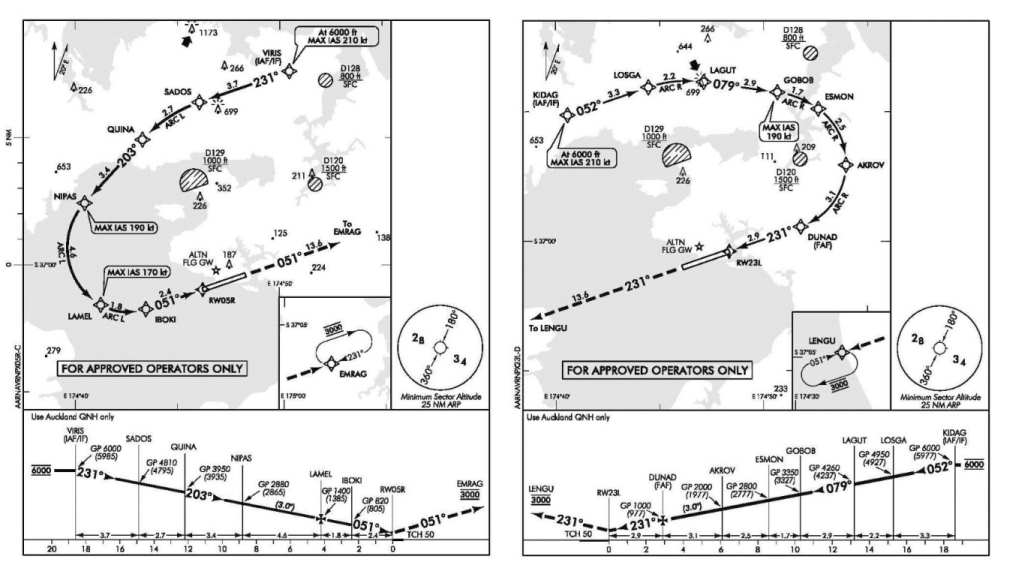
On May 2018, Airways New Zealand, Auckland Airport and the Board of Airline Representatives New Zealand (BARNZ) published the final report on the trial of the Yellow U23 SMART Approach flight path trial.
The decision to trial a third satellite-guided flight path to Auckland Airport from the north was publicly announced by the aviation industry in December 2014. The 12-month trial commenced on 1 September 2015 and concluded on 31 August 2016. The trial flight path was used between 7am and 10pm by up to 10 aircraft per day. It was flown by 441 aircraft, saving 3,396 nautical miles and 78,710 kilogrammes of fuel, and reducing carbon dioxide emissions by 248,724 kilogrammes. Noise experts concluded that the difference in noise exposure on a day with 10 Yellow U23 SMART
Approach flights and a day with no Yellow U23 SMART Approach flights was less than one decibel, or imperceptible, at most monitor sites.
A draft report on the trial was published on 20 October 2017 and was followed by a public consultation process. Written submissions on the draft report were accepted until 15 November 2017, and there was an opportunity for members of the community to present their submissions in person.
Additional information about the results of the 2015-2016 Yellow U23 SMART Approach flight path trial is available in the final report and in the accompanying reports by Airways New Zealand, BARNZ, and Marshall Day Acoustics.
As a result of the 2015-2016 Yellow U23 SMART Approach flight path trial and the public feedback on the draft report, Airways, BARNZ and Auckland Airport recommend the following:
- The Yellow U23 SMART Approach flight path to Auckland Airport should be modified to further reduce its impact on the communities of Cockle Bay and Whitford.
- The modified Yellow U23 SMART Approach flight path to Auckland Airport, known as Yellow U23A, should be adopted for operational use in March 2019.
- A maximum of six flights per day may use the Yellow U23A SMART Approach flight path.
- Aircraft may only use the Yellow U23A SMART Approach flight path between the hours of 7am and 10pm.
- The number of Yellow U23A SMART Approaches per day may be increased to a maximum of 10, provided that: 5.1 Auckland Airport is satisfied that there is a consistent and ongoing demand for the additional Yellow U23A SMART Approaches 5.2. Any increase in the maximum number of Yellow U23A SMART Approaches above six per day is staged5.3. The Aircraft Noise Community Consultative Group (ANCCG) has been consulted on the proposal to increase the maximum number of Yellow U23A SMART Approaches above six per day.
- A further SMART Approach flight path to Auckland Airport from the south to Runway 23L, known as Orange S23, should be trialled from March 2019, provided that all trial methodology and assessment criteria have been confirmed including public notification.
Auckland Airport agreed with the above recommendations under CAR Part 173.201(d).
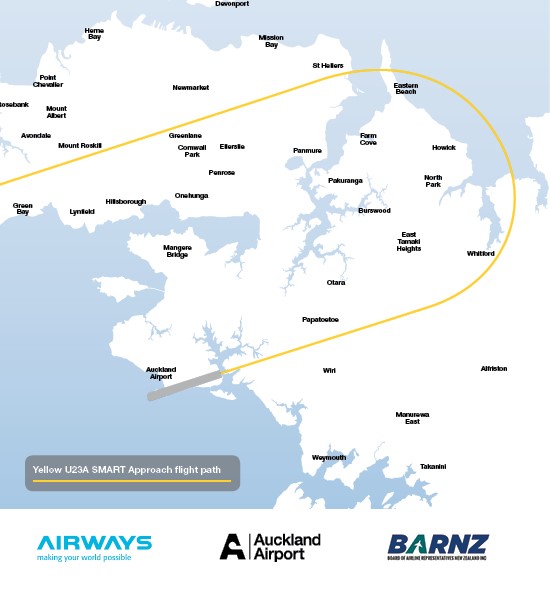
A new SMART track called ‘Orange S23’ was implemented in September 2019 on a trial basis. This track was implemented to provide an additional option to the Red SMART track which has been in operation since 2012 and overflies the populated area of Wattle Downs and Manurewa.
In early 2020, usage of Orange track ceased after several months of the 12-month trial to recalibrate the arrival profile slightly. The track commenced usage again in September 2020, but the usage of this track is significantly reduced due to the COVID-19 pandemic. The trial will occur for a further full 12-month period and end in September 2021.
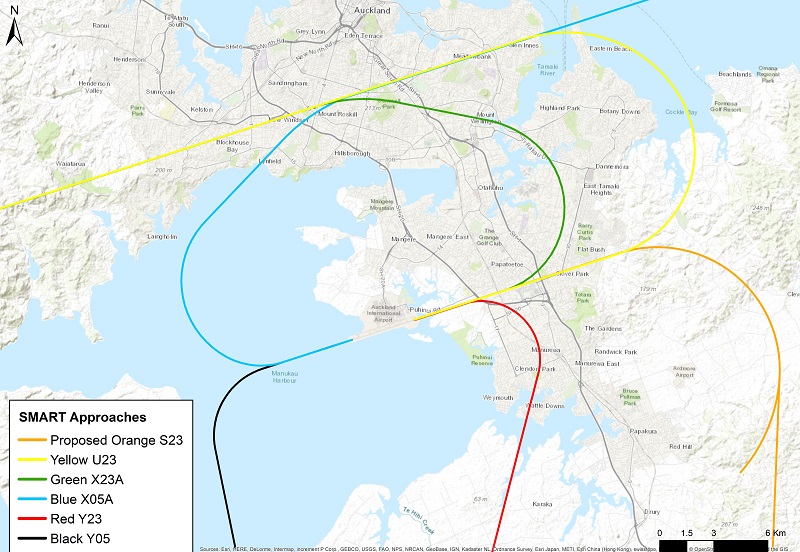
Click here to view the final report of the SMART Flight Path Trial.
Trial to temporarily increase daily limits on existing northern SMART approach tracks
Auckland Airport and Airways are running a short‑term trial to understand the impact of increasing how often three existing northern SMART Approach flight paths can be used per day (the daily limit or cap).
The approaches included in the trial are:
- Green (RNP X RWY 23)
- Blue (RNP X RWY 05)
- Yellow (RNP U RWY 23)
What is changing during the trial?
The number of aircraft per day allowed to use these existing approaches will temporarily increase. Based on current information, Airways has forecast that the highest number of daily flights during the trial will likely be lower than the trial caps.
Northern SMART approach |
| Average daily flight count (2025) | Current daily cap | Trial daily cap | Forecast daily maximum during trial |
Green (RNP X RWY 23) |
| 4.2 | 10 | 20 | 13 |
Blue (RNP X RWY 05) |
| 0.2 | 10 | 20 | 10 |
Yellow (RNP U RWY 23) |
| 0.05 | 6 | 12 | 6 |
The trial applies only to flights arriving between 7:00am and 10:00pm. Existing operating hours remain unchanged.
No new flight paths are being introduced as part of this trial.
When will the trial occur?
The trial is planned to run for three months within a five‑month window, starting from 1 April 2026. Use of the SMART Approaches during this period will be intermittent and will depend on airspace, traffic and weather conditions.
What might people notice?
SMART Approaches use more precise navigation. This means aircraft tend to follow a more consistent corridor. As a result, on days when these approaches are used more often, some communities may notice more frequent overflights.
The trial is intended to better understand how changes in frequency are experienced by communities in practice.
What does this trial not change?
- It does not increase the total number of flights arriving at Auckland Airport.
- It is not a permanent change to flight paths or daily limits.
- It does not change existing night‑time rules or operating restrictions.
How will the trial be monitored?
Monitoring during the trial includes:
- noise monitoring before, during and after the trial, including redeployment of additional noise monitors in locations relevant to the northern SMART approaches
- weekly reporting by Airways to Auckland Airport on how often the approaches are used
- ongoing review of noise complaints, including identifying which relate to the northern SMART approaches
What would stop the trial?
If monitoring identifies a material increase in noise, the trial will be halted, and the daily caps will revert to pre‑trial levels while the issue is investigated.
What happens after the trial?
The results of the trial will be assessed and reported back to the Aircraft Noise Community Consultative Group (ANCCG).
Any consideration of further changes – including whether the caps should remain, change, or be removed – would be considered separately, informed by trial results, and would involve further engagement before decisions are made.
Information shared with the ANCCG, including agendas, minutes and trial papers, is publicly available on Auckland Airport’s Community Engagement on Aircraft Noise webpage.